

Introduction
The German invasion of France and the Low Countries that began on 10 May 1940 caught the British, French, Dutch and Belgians off guard. With troops and tanks of the Heer sweeping through the Ardennes, Allied forces found themselves out of position. With the Germans having reached the Meuse on 12 May, the French hoped that their advance would be slowed as they attempted to force a bridgehead across the river. In what became known as the Battle of Sedan, the Germans were able to break French defensive positions at Sedan and effectively flank the Maginot Line by 15 May. With the roads now open, German troops surged forward in a rush to the English Channel to the west and north-west, and Paris to the south-west. One of the main formations involved in the fighting was the 12. Armee, whose Koluft (Kommandeur der Luftwaffe, whose role was to coordinate army and air force efforts) was Generalmajor Ernst Krüger. Under his command and heavily involved in supporting the German offensive was a short-range, tactical reconnaissance unit, the 2. Staffel of Aufklärungsgruppe 14 (or 2.(H)/14, for short), equipped with the Henschel 126 and Fieseler 156 Storch. 16 May 1940 would prove to be a hectic day for the Staffel, as 12. Armee crossed the Meuse in force, including armoured forces and a division of mountain troops that pushed towards and then beyond the historic town of Rocroi.
Orders for the Day
Having moved forward to a temporary airstrip at Flamierge not long after the invasion began, elements of 2.(H)/14 soon moved to Framont on 14 May, although some crews also transferred to the Belgium town of Opont that afternoon. At times like these with rapid army advances, the short-range reconnaissance units had to be very mobile to keep up with the fighting, and agricultural fields became temporary airstrips.
Throughout 15 May the Staffel was engaged in monitoring enemy forces in and around Rocroi, to provide intelligence for the forthcoming German army advance in that direction. By 18:30 that evening, one of the Staffel’s observers (and a future Staffelkapitän), Lt. Ernst von Weyrauch, reported that the German spearhead had reached the nearby bow in the Meuse River, south of Monthermé, where troops marked their positions with cloth blankets.
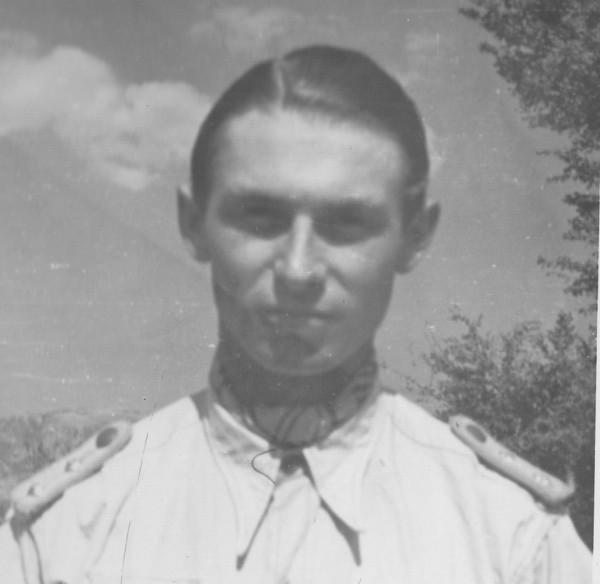
In its Armeebefehl Nummer 8 (Army Order Number 8) issued on 16 May 1940, 12. Armee was understandably concerned about strengthening enemy counterattacks against its bridgehead over the Meuse, so the observations provided by short-range reconnaissance units would be very important in monitoring for any potential threats.
With just five Henschel 126s serviceable on 16 May, it was clear that the available crews would be forced to rotate aircraft throughout the day to provide accurate reports about the position of, and situation at, the very fluid front. First into the air that morning were pilot Uffz. Steinert and 28-year-old observer Lt. Hans Freiherr von Rüxleben in Hs 126 ‘5F + GK’, taking off from Opont at 06:00. They were closely followed by two other crews in ‘5F + DK’ and ‘5F + FK’, although the latter, with Staffelkapitän Major Menzel acting as observer, took off from a nearby field at Maissin. Menzel was described by one of his subordinates as: “a delicate, sensitive man with a keen mind.”
Like the crews in ‘DK’ and ‘FK’, the focus for Steinert and von Rüxleben was the Meuse in front of Rocroi; their specific flight path being Opont to Fumay, and then south along the Meuse to Les Mazures, before returning to Opont. Reaching Rocroi at 06:20, five minutes later von Rüxleben reported a French battalion heading towards Éteignières, approaching the town from the south-west side. Operating at a height of between 100 and 200 metres, the Germans were engaged by machine-gun and anti-aircraft fire. Sustaining damage to the flaps and reporting the oil tank “shot through”, Steinert turned the aircraft towards German lines. Soon thereafter, a twin-engine French Potez 63 attacked the damaged Henschel in a lengthy running battle that forced the German crew down at Lombut, seventeen kilometres east of Sedan, and a long way from where the combat started. Initially reported as missing, both Germans were eventually able to return to their unit, submitting a final report on the day’s action at 20:00. However, this would not be the end of the day’s operations for either the Staffel, or ‘5F + GK’.
Seemingly repaired and ferried back to Opont, at 11:16 a different crew took to the air in ‘5F + GK’, underscoring the intense pressure the Staffel was operating under in order to support the forward elements of German ground units. At the controls was Obgefr. Bunger, while his observer was Lt. Gerhard Kopp.
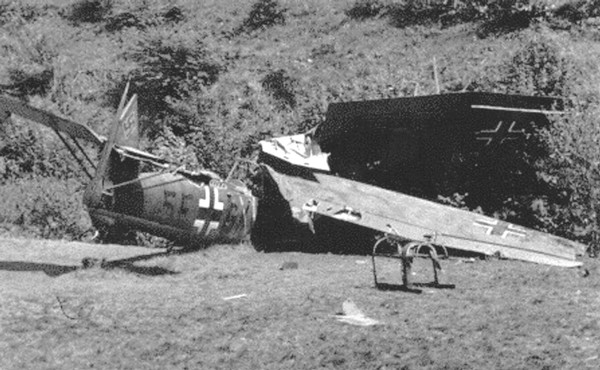

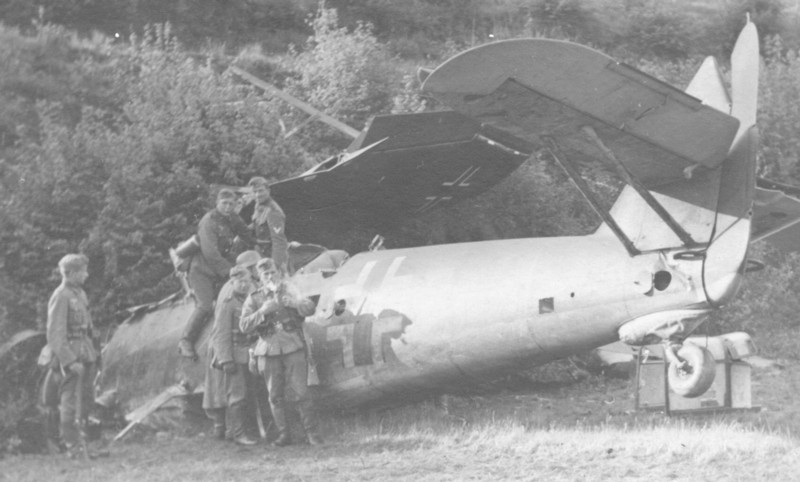
Tasked with flying the aircraft on road reconnaissance from Opont to Naux via Bièvre, the Henschel’s engine failed at an altitude of 1.200 metres and Bunger was forced to perform a crash-landing one kilometre north of Naux. Although both Bunger and Kopp walked away from the landing, ‘5F + GK’ was listed as a write-off. Several photographs of the wreckage confirm the extent of the damage.
Despite the loss, operations continued, and not long after the crash-landing by Bunger and Kopp, Ofw. Hönig and Oblt. Lenz took off in ‘5F + HK’, recording the effects of a German bombing raid on Rocroi. Landing at 12:26, they were followed into the air by three more sorties, totalling just over three hours of flight time. The last of these, undertaken by pilot Uffz. Günter Adam (later killed in an Fw 190 with NAGr. 13) and observer Oblt. Heinrich-Peter Gehrken (who would serve as a reconnaissance pilot until the very end of the war) in the Hs 126 coded ‘5F + EK’, landed at Opont at 20:13, having observed roads and vehicle traffic in the areas of Hirson, Fourmies, La Capelle and Vervins. Hirson and La Capelle had both been reached by the tanks of 6. Panzer–Division, and are 40 and 50 kilometres from the Meuse respectively, which shows just how successful the day had been for the men of 12. Armee.
Conclusion
Despite having just five serviceable aircraft at the start of the day, and suffering the loss of ‘5F + GK’ during the morning, 2.(H)/14 recorded more than nine hours of flight time during 16 May, providing valuable intelligence reports for German ground forces pushing forward. As the German drive towards Paris and the Channel continued in the coming days, the Staffel would continue to move forward in support, but in doing so, would see its ranks of aircraft and air crew thinned even further.
Postscript
While the primary sources make it clear that ‘5F + GK’ was airborne after it initially suffered damage during its morning sortie with Steinert and von Rüxleben, it does seem rather incredible that the Staffel was able to repair the aircraft in such a short period of time, and under frontline conditions, and ferry it back to Opont. If any of our readers have anything extra to add that may help clarify the events around 16 May and the participation of ‘5F + GK’ in a second mission, we would love to hear from you via our contact page.
Primary Sources
BA-MA RH 2-KART/10144, Lage West 16. Mai 1940
BA-MA RL 10/372, Flieger und Fliegerabwurfmeldungen 2.(H)/14
NARA RG 242 T-312 R-422, 12. Armee Ia Tagesmeldungen, 10 May-19 December 1940
NARA RG 242 T-312 R-425, 12. Armee Koluft
Secondary Sources
Défieux, Jean-Pierre Répertoire des Unités Aériennes de la Luftwaffe 1935-1945: Reconnaissance Aéronavale, unpublished manuscript.
deZeng, Larry & Stankey, Douglas G. ‘Luftwaffe Officer Career Summaries’, 2024.
Ommert, Stefan Recon For Rommel, The 2.(H)/14 – Air Recon Flyers in Africa, König Verlag, Krefeld, 2006.
Schultze-Quentell, Günter Erlebnisbericht eines jungen deutschen Offiziers aus dem 2. Weltkrieg, unpublished manuscript, 1944.
Urbanke, Axel, Petrick, Peter, Stemmer, Gerhard & Balke, Ulf Embleme der Luftwaffe Band 1: Nah- und Fernaufklärer, Luftfahrtverlag Start, Bad Zwischenahn, 2018.
Electronic Sources
deZeng, Larry ‘Kommandeur der Luftwaffe (Koluft)’, https://www.luftwaffedata.co.uk/index.php/Kommandeur_der_Luftwaffe_(Koluft)
Mitchell, Clint ‘Luftwaffe Research Group’, www.luftwaffe-research-group.com
Acknowledgements
John Colvin, Andy Mitchell, Stefan Ommert, Schultze-Quentell family, Robert Szoltyk


