
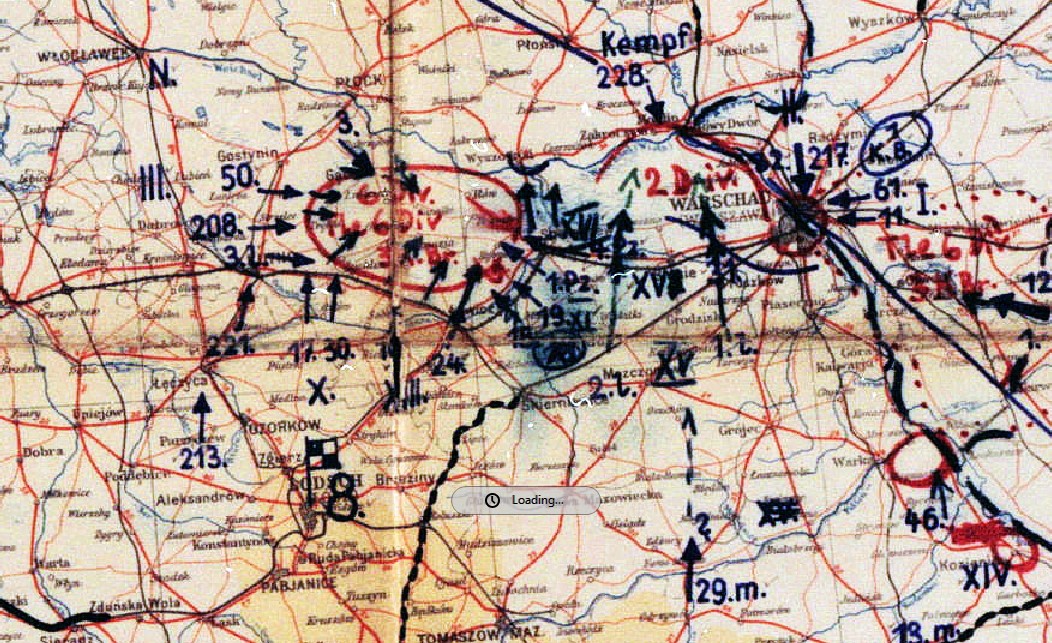
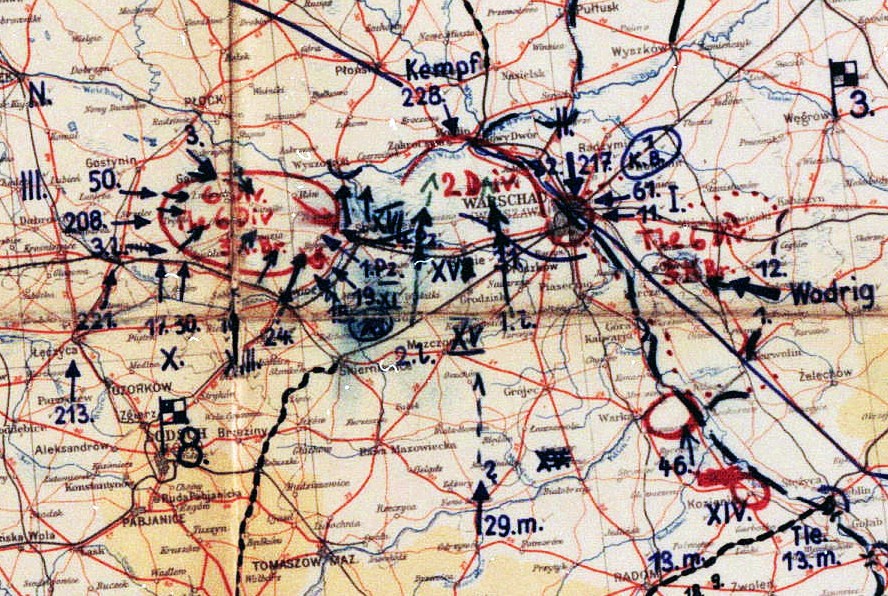
With the German invasion of Poland two-and-a-half weeks old, by 16 September 1939 the Luftwaffe had effectively negated the threat of Polish Military Aviation – the Polskie Lotnictwo Wojskowe – and was free to operate with relative impunity from fighter interception. Although elements of the Polish fighter force still attempted to mount a defence of their homeland, its strength was greatly weakened. This allowed German planners to turn the attention of the Luftwaffe away from air superiority operations and instead focus on the land campaign. In striking range of the Polish capital, it was at this time that Warsaw became a primary target of Luftwaffe planners (although it had already been subject to several very damaging German air raids). The seat of the Polish government was viewed by the Germans as a source of resistance, and a major raid on the capital had been planned for 16 September, but it had been postponed by 24 hours. One unit detailed to form part of that bombing operation was the Stabsstaffel of Kampfgeschwader 4, based 125 kilometres west-south-west of Warsaw, at Lodz-Lublinek airfield.

Having been notified on 16 September that it was to participate in a raid on the Polish capital the following day, during the night of 16/17 September the Staffel received a cancellation order. Reporting three available He 111 P bombers, the Stabsstaffel was instead tasked with supporting the German 8. Armee in its fight against Polish forces. With so few aircraft available, the Stabsstaffel was to be employed as an armed reconnaissance unit. As such, at 05:25, the Geschwaderkommodore, Oberst Martin Fiebig, took off in a Heinkel coded ‘5J + AA’ for a reconnaissance sortie that overflew Kutno, Żychlin, Sochaczew, Wyszogród, Płock and Gostynin. These locations marked the approximate ‘frontline’ of an encircled and battered Polish army force, most of which would be compelled to surrender in coming days. Landing at 07:20 in Lodz, Fiebig noted in his after-action report, in part, that “some small columns from Gabin towards Wymyśle Polskie (horse-drawn covered wagons). Long columns from Wymyśle Polskie towards Iłów (vehicles, artillery, infantry). Columns from Iłów towards Młodzieszyn (eight kilometres north-west of Sochaczew) in the eastern direction.” The Polish troops observed by Fiebig were making a desperate eastward dash towards Warsaw, unaware that their path was already barred by troops and tanks of 8. Armee and 10. Armee.
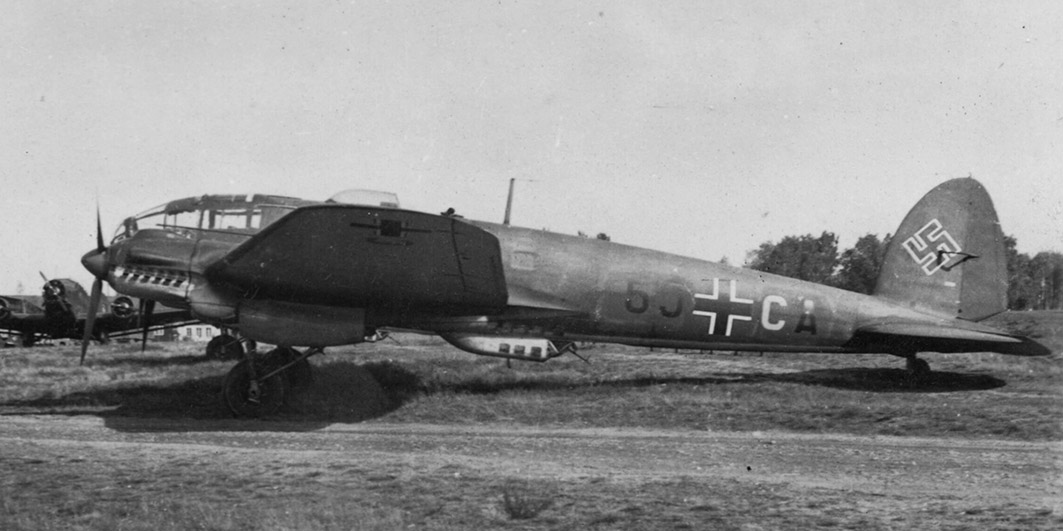
Operating at the same time was Oblt. Karl-Heinrich Fischer, who took off at 05:35 in ‘5J + CA’. Overflying the same area, Fischer dropped sixteen SC 50 bombs on enemy troops on the road between Gabin and Giżyce. Claiming that the bombing was successful, the results are unknown. Landing at Lodz-Lublinek at 07:50, Fischer’s attack was not the only one conducted during the day by the Stabsstaffel.
Having already undertaken a sortie earlier in the morning, Oberst Fiebig took to the air again at 10:40 in ‘5J + AA’ to reconnoitor the area of Sochaczew-Wyszogród-Modlin. Twelve kilometres south-west of Modlin, Fiebig, who was acting as the Beobachter, ordered pilot Oblt. Horst Camphausen to reduce altitude and overfly a military column so that it could be strafed. No doubt panicking their Polish target, the attack was not all one-sided. As they passed over the column, the Poles returned fire and damaged the Heinkel’s port engine, holing the fuselage, aileron and flaps, while Camphausen was wounded by the groundfire. Landing at Langenau, ‘5J + AA’ was reported as having suffered ten per cent damage. Although this could be repaired by groundcrew, it would mean that the Geschwaderkommodore’s aircraft would be out of action for what was estimated to be at least two days.

The Stabsstaffel of Kampfgeschwader 4 would not see action again for some time, as it returned to Erfurt on 21 September to rest and refit. Its Kommodore, Oberst Martin Fiebig, would go on to greater things with the Luftwaffe. He commanded VIII. Fliegerkorps during the disastrous airlift campaign to support the encircled German 6. Armee at Stalingrad during the winter of 1942/1943, and later led X. Fliegerkorps in the eastern Mediterranean. Sentenced to death by a Yugoslavian court for war crimes, he was executed on 23 October 1947. The Geschwader he led to war would fight throughout the conflict, with the Stab quartered at Königgrätz for the last few weeks of the war. Horst Camphausen recovered from his wounds, only to lose his life in May 1940. As for Karl-Heinrich Fischer, he transferred to the staff of Fliegerführer 3 in mid-1943, and later commanded long-range reconaissance unit 4.(F)/14, where he was very well liked by his subordinates. The story of his close escape in April 1944 features elsewhere on the Air War Publications site, in our blog post. His ultimate fate is unknown.
Sources
Primary Sources
BA-MA RL 10/20
BA-MA RL 10/24
BA-MA RL 10/56
Secondary Sources
deZeng, Larry & Stankey, Doug ‘Luftwaffe Officer Career Summaries’, 2024.
Holm, Michael ‘The Luftwaffe, 1933-45’, http://www.ww2.dk
Lahrssen, Edgar 4 Jahre am Steuerknuppel, self-published, undated.
Acknowledgements
Robert Szoltyk, Lahrssen family


