
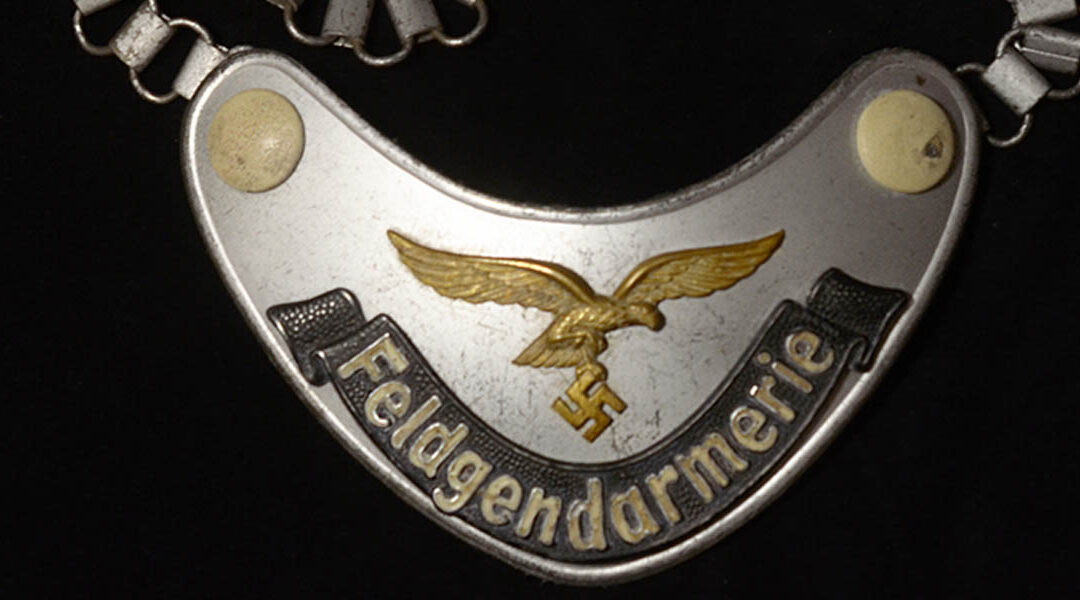
Introduction
The need for discipline is paramount in any armed force, and the Luftwaffe during the Second World War was no different. Throughout the existence of the German air force, thousands of servicemen were arrested, charged, and sentenced to varying degrees of punishment for crimes that ranged from the trivial to the treasonous. While such punishments were no doubt indicative of the crimes they were levied against during peacetime, the onset of war in September 1939 necessarily changed the dynamics of sentencing. By 1941, a growing manpower shortage was beginning to take its toll, and the German military judicial system could no longer afford to sentence criminal behaviour to the same standards that it had done just three years earlier. Yet, such was the need for discipline in the armed forces, even the slightest of crimes was still recorded and the unfortunate soldiers forced to defend themselves in front of military tribunals. Punishments ranged from house arrest, or a reduction in rank, to service in an infantry unit or burial without military honours. The experience of several such individuals is recorded below.
Drunk and Disorderly
In late-July 1941, a gathering of personnel from the 3. Staffel of Küstenfliegergruppe 906 ended with two men facing a military tribunal. The unit was based in Norway at the time, operating the Do 18 flying boat. Having consumed an excess of alcohol during the gathering, a disagreement broke out between Lt. Günter Keller and Oblt. Franz Gerig. This disagreement soon turned physical and the Staffelkapitän of 3./906, Hptm. Ludwig von Müller, was duly called upon to separate the two feuding officers, forcing himself between the two men. The enraged Gerig threw a punch at Keller, but instead hit von Müller. The two junior officers were immediately arrested and placed on trial. Learning their fate on 6 August 1941, Gerig was sentenced to five weeks confinement for insubordination, while Keller was likewise confined to quarters, although only for ten days. Given what they could have faced as punishment, it is no doubt likely that both men were thankful for such leniency!
This was just one of the many twists and turns in the military service of Heinz Keller, who had undertaken U-boat training in 1937, before transitioning to the Küstenflieger to serve as a Beobachter. He remained in that role until July 1943, and in 1944 and 1945 commanded Type VIIIC submarine U-683. Kapitänleutnant Keller and his 48 crewmen were lost eighteen days into their first patrol, on 20 February 1945.
Damaging State Property
One of the other crimes often held against Luftwaffe personnel was that of causing damage to, or destruction of, equipment. Even if such damage or destruction was unintentional or minimal, individuals would often be reported for investigation. Such was the case for Lt. Adolf Müller of the Gruppenstab of III./KGzbV 1, who slightly damaged one of his unit’s Ju 52s in June 1941. It was listed as two to three per cent damaged, but the unfortunate pilot was sentenced to one week of house arrest, possibly because, according to a member of the Gruppe, it was too difficult a job to repair at that moment and would require three to four weeks before it would be made operational again. Müller would later be awarded the Deutsches Kreuz in Gold, and as an experienced pilot, transferred to a variety of training units to serve in the role of instructor.
Another individual reported for damaging an aircraft was Lt. Walter Müller of 2.(H)/32, who was charged with negligent damage to a Fi 156 that he was piloting during August 1942. During take-off, Müller was forced to suddenly veer to the left to avoid colliding with an unsighted obstacle. In doing so, the Storch suffered significant damage that was assessed to be 35 per cent. Pleading his defence on 1 September 1942, he was found to have no case to answer and was acquitted.
Not so lucky in a similar case was Oblt. Rolf Müller of advanced training unit 7./StG 101, who was charged with disobeying flight directives. Coming in to land, Müller was accused of inattention and failing to observe the wind direction indicated by the windsock at his local airfield. Instead of landing into the wind, Müller instead attempted his landing with a strong tail wind. This inevitably elongated his landing run and caused what was described as “considerable damage” to the aircraft under his control. Subsequently charged, on 26 June 1943 he was sentenced to four weeks’ confinement to quarters. However, after review, this sentence was suspended on 19 August 1943 until after the war. Müller was again in trouble in May 1944, when he was charged with insubordination and sentenced to yet more house arrest. Despite his conviction, it does not appear to have hindered Müller’s career, as he became the Staffelkapitan of ground-attack training unit 2./SG 104 later that year, albeit still with the rank of Oberleutnant, as it was noted on 20 September that he was “not yet fit for promotion.”
A more serious outcome was that handed down against Ofw. Kurt Gutmann, who was a student at the Flugzeugführerschule A/B 52 at Danzig. On 21 August 1942, Gutmann was piloting a Bü 181 over Lowitz, when he flew over a women’s camp. Attempting a display for the women, Gutmann flew a series of tight turns below the prescribed height. Gutmann then failed to pull out of a steep turn, and crashed into a nearby lake, killing both himself, and his observer, Gefr. Leopold Weiß. Tried post-mortem, Gutmann was found guilty of a slew of charges, and the court issued the sentence that he was to be denied military honours at his interment.
To Impugn the Honour
One of the core aspects of any officer tradition is integrity and respect. Within the Luftwaffe this was no different, and so it is not surprising to find individuals charged with actions that brought themselves and others into disrepute. One of the ways an officer within the Luftwaffe could do this was demonstrated by Lt. Karl Stanzl of Aufklärungsgruppe 122. During a winter skiing vacation, Stanzl had chanced upon a married woman who revealed to him that her marriage had broken down. Much taken by the woman, Stanzl repeatedly assured the unnamed Frau that should she divorce her husband, he would offer his own marriage proposal. Upon hearing of this affront to both his honour and marriage, the estranged husband promptly filed a complaint against the young Leutnant, which the courts ultimately decided to reject, but no doubt left all three parties involved more circumspect in their behaviour.
A more severe instance of this kind of charge was demonstrated by Hptm. Richard Albrecht. Born in 1915, Albrecht was a flight instructor in 1939 before being transferred to various transport Staffeln during 1940 and 1941. Briefly returning to his duties as a flight instructor in 1942, Albrecht was transferred to IV./KG 1 a year later, and was wounded during an Allied raid on Grottaglie airfield in June 1943. Having recovered from his wounds, he was then transferred to the Frontfliegersammelgruppe 2 at Quedlinburg, and it was here that he made the grave misjudgement of writing a letter to a friend in which he complained bitterly about the losses suffered in Italy, whilst also making disparaging comments about the Luftwaffe‘s aircraft, which he said were too slow and unsuitable for the theatre of war in which he had found himself. To make matters worse, Albrecht bemoaned what he saw as a lack of leadership that no doubt led to unnecessary losses. Brought before a tribunal, he was acquitted of the charge of sowing discontent during January 1944. Having been temporarily placed on the Reserve List, no doubt while the charges against him were investigated, once exonerated, Albrecht went on to serve on temporary assignment with the 2. Lichtbildstaffel during May 1944. Albrecht would not survive the war and was killed during its closing stages, on 24 March 1945. He is buried in the German War Cemetery at Weeze in western Germany.
Misuse of State Property
From damaging or destroying military property, to its misuse, tight regulations governed how servicemen could interact with the equipment the Wehrmacht provided them. One clear rule that all soldiers knew of, but some chose to ignore, was that military equipment was under no circumstances to be used for personal edification. For Oblt. Günter Näder of 5./KG 2, temptation obviously got the better of him during early 1943 when he was caught absconding with a service vehicle, attempting to drive the short distance home (it is not recorded where ‘home’ was). Charged with military disobedience, on 14 March 1943 Näder was sentenced to four weeks’ house arrest. Remaining with his Staffel after the verdict, Näder would be killed on 3 September 1943, when the Me 410 A-1 he was piloting suffered engine failure and subsequently crashed approximately four kilometres east of Zeist in the Netherlands.
Manslaughter
Undoubtedly there were incidents of pre-meditated murder throughout all branches of the Wehrmacht, but one form of unlawful killing that seems curiously under-punished was that of negligent homicide. In June 1942, Lt. Heinz Necknig of 4./KGzbV 1 was assigned to fly a Ju 52 to Demyansk. However, before boarding the aircraft and taxiing, it was alleged that he failed to properly check that the runway was clear. As a result, an unnamed Unteroffizier was struck in the head by one of the Junkers’ propellers, resulting in the death of the unfortunate man. Charged with negligent homicide, on 19 June 1942 Necknig learnt that he was to serve three months in prison, although this was later amended to a six-week suspended sentence with the remaining custodial sentence to be served under house arrest. Interestingly, despite the seriousness of the charge, Necknig’s record was expunged on 27 August 1943, presumably for his exemplary service that had earned him the Ehrenpokal in June 1943. He later served as a Staffelkapitän, and passed away on 17 April 1985.
A similar case of judicial leniency was also applied to Lt. August Mack of 2./JG 54, who, in late-September or early October 1942, attacked a Soviet observation balloon that had been captured by the Germans and pressed into service. Failing to correctly identify the recently added national insignia, Mack fired on the balloon, which resulted in the death of the Ballonführer slung in the basket below. Duly charged, Mack was sentenced to four weeks’ house arrest on 12 October, although he would only serve two, with the remainder of the sentence suspended. Transferred to western Europe in early 1943 with his personal tally standing at twelve kills, Mack was killed in a mid-air collision on 28 May 1943 whilst serving with the advanced training unit Jagdgruppe West.
Conclusion
While the crimes and punishments discussed above concerned mostly lower-ranking individuals, even generals, Geschwaderkommodoren and Gruppenkommandeure were not immune to prosecution, and individuals like the Transportführer 2, Generalmajor ‘Fritz’ Morzik, and the Kommandeur of III./SKG 10, Hauptmann Fritz Schröter, found themselves before military tribunals for various reasons (much more regarding the case involving Schröter will be outlined in our forthcoming volume Fw 190 Fighting Over Southern Italy, and a summary is provided in our eArticle about him, available here). Although custodial sentences did appear light in comparison to the crimes committed – especially where loss of life or severe damage to property through negligence was concerned – it must be remembered that many rulings made it clear that any suspended sentence was imposed only to keep intact the cohesion of the military units the convicted individual served with; a tacit admission of the growing shortage of trained manpower experienced by the Luftwaffe at the front as the war progressed.
Primary Sources
BA-MA RW 59/1624
BA-MA RW 59/1625
BA-MA RW 59/1627
BA-MA RW 59/1628
BA-MA RW 59/1635
NA AIR 40/2976
Genst.Gen.Qu.6.Abt. Loss Lists
Secondary Sources
deZeng, Larry & Stankey, Douglas G. ‘Luftwaffe Officer Career Summaries’, 2024.
Electronic Sources
‘Forum Geschichte der Wehrmacht’, https://www.forum-der-wehrmacht.de/
‘Günter Keller’, https://uboat.net/men/commanders/590.html
Holm, Michael ‘The Luftwaffe, 1933-45’, https://www.ww2.dk/
‘The Kracker Luftwaffe Archive: Axis Powers Pilots and Crew’, https://aircrewremembered.com/KrackerDatabase/


